Chesapeake Community
Modeling Program
the new CCMP Newsletter | April 2008
Volume 1, Issue 1
Introduction
The Chesapeake Modeling Symposium (CheMS'08) is quickly approaching. We hope that the Symposium will give us a chance to connect with the larger Chesapeake community to better identify the role of CCMP and the kinds of services that we can provide to the community.

Contents
1. CheMS'08
2. Student Grants Available for CheMS'08
3. CCMP News in brief
4. News from other communities
5. CCMP Model & Data Repository, CheMS iPod Raffle
6. Models or data?
7. Featured Question @ CCMP Blog: Does CCMP need by-laws?
8. Featured Modeler: Claire Welty
9. Featured Model: CE-QUAL-ICM
1. CheMS'08
The CCMP was started as a top-down effort, when CRC was charged by the Linden Group to launch a community modeling effort to complement the existing modeling tools available for the Bay. Since then, CCMP has endeavored to forge a good connection to the community at large, but acceptance has been slow and enthusiasm lukewarm.
With the Chesapeake Modeling Symposium we are making yet another attempt to turn the process to the community and create a bottom-up thrust. We are asking the modeling community for guidelines so that CCMP can provide better service that is more relevant. We are trying to figure out what collaboration and networking tools are needed, as well as learn how CCMP can help develop the linkages and mechanisms for collaboration and sharing.
2. Student Grants Available for CheMS'08
Thanks to generous support of NSF we are announcing 10 student grants of $300 to cover registration and travel to the Symposium. The ten best student papers will be selected from those already submitted and the ones that will be submitted before the deadline of May 4th. Results will be announced before the symposium. Awards will be handed out at one of our plenaries. For more information, see the CheMS website.
3. CCMP News in brief
CE-QUAL-ICM Model Available via CCMP, SourceForge
The 4000-cell version of the CE-QUAL-ICM model by Carl Cerco from ERDC is now available on the CCMP website and SourceForge [link]. The model is one of the classic applications that is (was) part of the CBP modeling suite. It underwent rigorous testing and is a great opportunity for future community efforts (see below for more information about the model).
Availability of SPARROW (USGS)
John Brakebill from USGS indicated that the SPARROW model can be also made available over SourceForge. The problem is that the model is relying on proprietary statistical software. The expectation is that with the help of the community we can find open-source toolkits that could maybe do without the proprietary piece and produce an entirely open-source version of SPARROW.
PIHM: Available This Month!
Hold your breath! Chris Duffy and his associates Mukesh Kumar and Gopal Bhatt promised that their PIHM model will be available from SourceForge by the end of the month. We hope they meant April… that is, April 2008! PIHM is a great model that offers a whole new level of spatial resolution and much higher accuracy. It comes integrated to a specially designed GIS package. It is modular and may serve as a great platform to integrate additional processes and components.
4. News from other communities
WATERS Looking Beyond Hydrology
WATERS is a foster child of NSF, CUAHSI and CLEANER. It intends to expand hydrology beyond water to cover all sorts of environmental issues. It also is after the NSF instrumentation money (Major Research Equipment Facilities Construction - MREFC). On March 24-25 WATERS had their community workshop, where they solicited input into the proposed design of the network and plans for Phase II of the project office. They had also issued a Request for Information (RFI) and collected ideas from the whole community to put into a major NSF proposal. It is yet to be seen how this proposal will shape out and how the community will be organized. At this point there is much misunderstanding about the goals, the plans and the framework of this effort.
Community Modeling is Becoming Cool!
If you think CCMP is the only group building a modeling community, think again! There is a long history of community models. One such project is the Community Surface Dynamics Modeling System (CSDMS), which deals with the Earth's surface - "the ever-changing, dynamic interface between lithosphere, hydrosphere, cryosphere, and atmosphere". The CSDMS is funded by NSF and is rapidly developing. We have discovered many common issues and interests with CSDMS and intend to synchronize our efforts where possible.
Yet another endeavor is the CUAHSI Community Hydrologic Modeling Program (CHyMP). While this effort is still in planning stage, it is likely to move strongly ahead. In that case we will also try to make sure that we maintain compatibility with the models and data that will be coming out of this effort.
5. CCMP Model & Data Repository, CheMS iPod Raffle
We are developing an inventory of models and data sets. It will be made available through the CCMP website in order to stimulate cross-pollination across modeling teams and paradigms as well as encourage future community modeling efforts. As part of the preparation for the Symposium we are soliciting input for the inventory. When you submit your papers and/or presentations you will be asked to fill in a web form that will describe your model(s) and/or data set(s).
Why bother filling in the form? Your submission guarantees a spot in a raffle giveaway of a free iPod at the Symposium. The more models and data sets you register - the higher your chance of winning. A great opportunity for students. If your professor is too busy to make a submission - offer help. You will be the one who gets the prize. Just make sure that all the important information is provided (we will check).
6. Models or Data?
Really: both are important. There has been some discussion about the role of data in CCMP. If we are a community modeling program then why care about data? For one, models are rarely better than the data that inform them; we need data to build good models. Secondly, a data set is also a model, after all. Data are also simplifications of reality: they also have errors and we also calibrate instruments to obtain data. So, there is no big difference.
Our suggestion is to think of data as a special case of models and therefore give data sets and monitoring results an equally important seat under the CCMP umbrella.
Besides, models produce data as well. We can always treat model output as yet another data set, which should be also available for future reuse, archiving, comparison, etc.
7. Featured Question @ CCMP Blog: Does CCMP need by-laws?
We have created a blog in order to encourage interaction with the community. The question we want to ask you today: should CCMP develop By-Laws to make sure we have a clear & transparent structure and governing mechanism? There are many questions that are related: Who are the officers, how do they get elected? What are the committees? Where/When are the meetings, and how often? What are the working groups? Who makes up the Steering Committee? How to deal with education/knowledge? And so forth.
Your thoughts? Please share them with the community by leaving a comment on our blog.
8. Featured Modeler: Claire Welty
In each forthcoming newsletter we will spotlight a member of our community who is doing exciting work that everyone should know about. We will start with members of our Steering Committee (well, of course). Today, or featured modeler is:
Claire Welty, UMBC [homepage]
Claire joined the CCMP Steering Committee last year. She brings an important connection to hydrologic research in urban environments and a wealth of experience in groundwater studies. Claire is currently the director of an IGERT center for "Water in Urban Environment". This NSF-sponsored program supports establishment of a multidisciplinary PhD program in “Water in the Urban Environment” at UMBC. This program will train a generation of PhD students who understand linkages between ecological, economic and engineering approaches, as well as innovations in policy-making. These students will be prepared to work in multidisciplinary teams to improve understanding and management of urban environmental systems. The program is centered on three interwoven themes: (1) urban hydrology and contaminant transport; (2) urban biogeochemical cycles, aquatic ecosystems, and human health; and (3) urban water policy, management, and institutions.
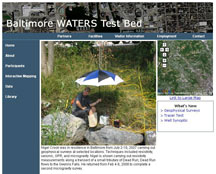 Claire is also a PI on three major projects funded by NSF and NOAA. With funding from NSF she is Quantifying Urban Groundwater in Environmental Field Facilities. Apparently groundwater is a Missing Link in Understanding How the Built Environment Affects the Hydrologic Cycle. That's the title of the project. See the project website for more info. Using the urban water budget as a unifying theme, they estimate the various elements of the budget in order to quantify the influence of urban infrastructure on groundwater. This work is closely related to the Baltimore urban LTER - Baltimore Ecosystem Study (BES).
Another NSF funded project is on "Dynamic Coupling of the Water Cycle with Patterns of Urban Growth". This project links an urban growth model (SLEUTH) with a fully-coupled, physically-based three-dimensional hydrologic model (PARFLOW-CLM) to evaluate the effects of growth on water availability and limits to water supply also using the Baltimore metropolitan region as a case study. A recently started NOAA-funded project is on "integrating Real-Time Sensor Networks, Data Assimilation, and Predictive Modeling to Assess the Effects of Climate Variability on Water Resources in an Urbanizing Landscape".
Claire is also co-PI on project funded by NASA. "WaterNet: The NASA Water Cycle Solutions Network". This project is developing WaterNet by engaging relevant NASA water cycle research resources and community-of-practice organizations to develop an “actionable database” that can be used to communicate and connect NASA Water Cycle research Results towards the improvement of water-related Decision Support Tools. It is much appreciated that, on top of all these responsibilities, Claire finds the time to sit on our Steering Committee and steer CCMP towards our goals.
9. Featured Model: CE-QUAL-ICM
We will also begin to regularly showcase models in our community (and this includes data). Today, our featured model is:
CE-QUAL-ICM 3-D Eutrophication Model
CE-QUAL-ICM is s a three-dimensional eutrophication model for the Chesapeake Bay and major tributaries developed by researchers at the U.S. Army Corps of Engineers (ACE) Engineering Research and Development Center (ERDC) in Vicksburg, MS. This model study was sponsored by the Chesapeake Bay Program Office (CBPO), U.S. Environmental Protection Agency, and the U.S. Army Engineer District, Baltimore (CENAB). We need to compliment Carl Cerco for releasing not just the model binaries, but also the source code for the model and making it a truly open modeling project. This is probably one of the first ACE products that is available on SourceForge.
Thank you Carl!
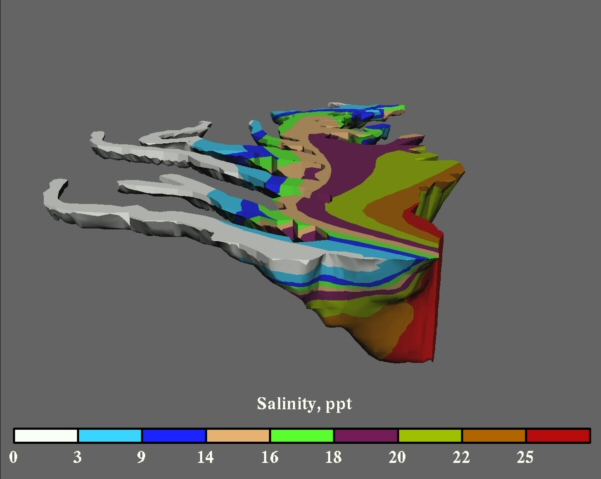 The model operates on a 4,000-cell three-dimensional grid and includes twenty-two state variables, each of which can be activated or deactivated depending on the application. Another feature of the model is that it includes the computation and reporting of concentrations, mass transport, kinetics transformations, and mass balances. Model calibration and validation were performed using the monitoring data base maintained by the CBPO.
A limitation is that the model does not compute hydrodynamics. Hydrodynamics must be specified in binary or ASCII format and read into the model. Three years of hydrodynamics, 1984-1986 are provided as a download for use with this model. This makes it only more exciting if we consider coupling the model with other open source models that are already served by CCMP (for example, ChesROMS).
Chesapeake Community Model Program
http://ches.communitymodeling.org/
Chesapeake Research Consortium
Edgewater, MD
410-798-1283